
Date: November 17, 2026
Since 2002, more than 250 million hectares of forests have moved into owned by or designated for Indigenous Peoples, Afro-descendant Peoples, and local communities.
But secure rights alone do not guarantee thriving livelihoods. A community may have recognized rights to its territory but still lack access to infrastructure, finance, skills, responsive institutions, or the ability to exercise its own governance systems.
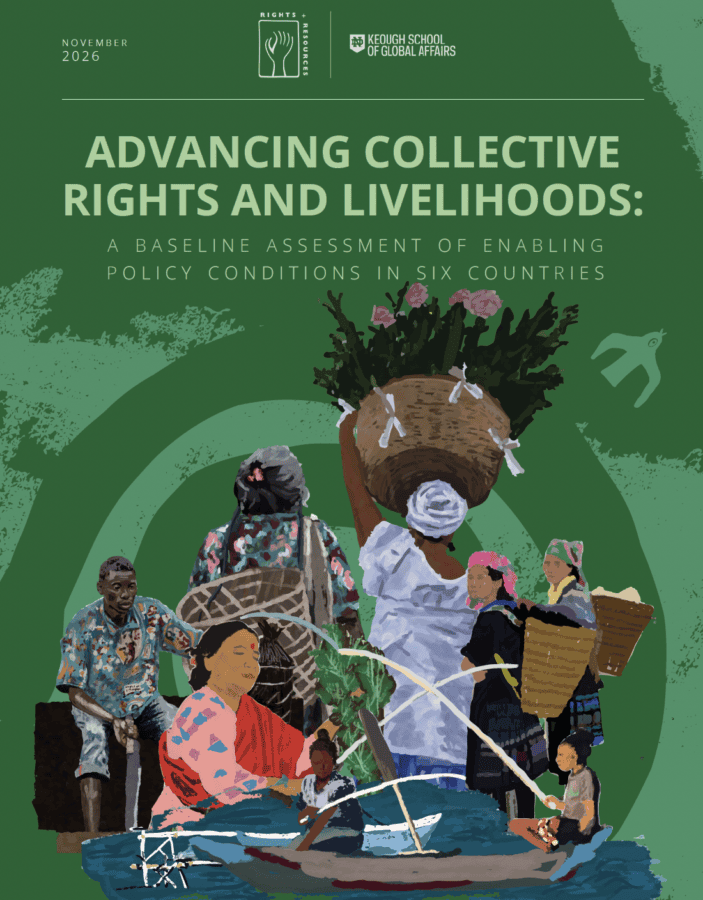
Until now, there has been no common global evidence base to assess and compare these broader conditions. Developed by the Rights and Resources Initiative (RRI), the University of Notre Dame’s Keough School of Global Affairs, and a global rightsholder steering committee, this baseline addresses this gap by examining five interconnected conditions that make collective livelihoods possible: tenure security; institutional autonomy and accountability; livelihood development and capacity building; infrastructure and connectivity; and inclusive governance and cultural respect.
The baseline provides a new way to identify gaps in the laws, policies, institutions, and conditions that shape collective livelihoods. Drawing on evidence from six countries—Brazil, the Democratic Republic of Congo (DRC), Indonesia, Nepal and Peru—the baseline illuminates the real conditions for collective livelihoods, which is the very first step towards changing them.
As climate action and investment take shape, this evidence can help inform advocacy, policy dialogue, and collective action to ensure communities can exercise their rights and pursue their own development aspirations.
The report is available in four parts:
- Advancing Collective Rights and Livelihoods: Global Report
- Annex 1: Technical Annex
- Annex 2: Country Profiles
- Annex 3: Tables
https://doi.org/10.53892/ATRL1536