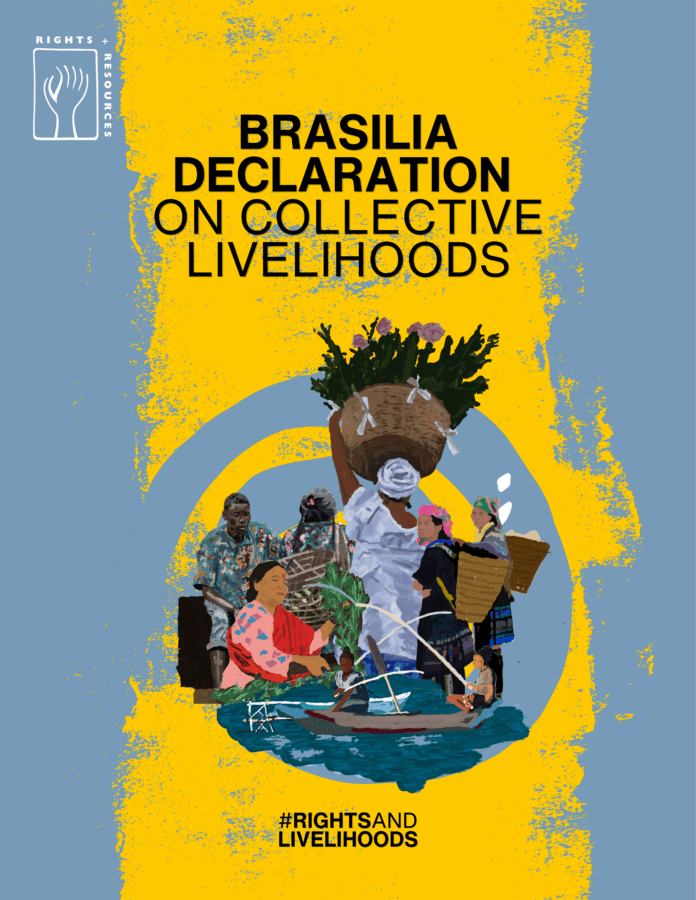
Washington, D.C. June 23, 2026–How does the promise of land rights translate into reality? This question is at the heart of a new global call from Indigenous Peoples, Afro-descendant Peoples, local and traditional communities for governments and global institutions to recognize their collective economies as essential pillars of environmental action and sustainable development.
The Brasília Declaration was adopted at the conclusion of the first-ever Global Summit on Collective Livelihoods & Conservation in Brasília, Brazil on May 29, 2026. It argues that while secure collective rights remain an essential foundation, rights alone are insufficient. Lasting climate, conservation, and development outcomes require conditions that allow communities to translate legal rights into thriving livelihoods and long-term stewardship of ecosystems.
150 participants from 26 countries attended the summit, which was convened by the Rights and Resources Initiative (RRI), a global solidarity network that advances the rights and priorities of Indigenous Peoples, Afro-descendant Peoples, and local communities in global policy, finance, and market systems. It was co-organized with Brazil’s Ministry for Racial Justice and four Brazilian organizations: The Articulation of Indigenous Peoples of Brazil (APIB); Coordination of Indigenous Organizations of the Brazilian Amazon (COIAB); National Coordination of Articulation of Rural Black Quilombola Communities (CONAQ); and the Interstate Movement of Babassu Coconut Breakers (MIQCB), in partnership with the German Agency for International Cooperation (GIZ).
Congresswoman Sônia Guajajara, Brazil’s former Minister of Indigenous Peoples, reminded the participants that even as global commitments for Indigenous Peoples and local communities continue to grow, they have yet to overcome the policy, finance, and market barriers that prevent rights from turning into power, resources and opportunities to sustain them and their ecosystems.
“Even as the world applauds us as the guardians of territories, we still face violence, exclusion, and brutal pressures from economic predators that exploit our systems, (such as) land grabbers, mining companies, and agribusiness expansion supported by policies that only care about certain interests, not us or our ecosystems,” Guajajara said in her keynote address.
Vania Komegi, Deputy CEO of EcoNusa Foundation in Indonesia emphasized the importance of ensuring that Indigenous Peoples and local communities participate as economic actors rather than remaining at the lowest levels of global value chains.
Komegi, whose work focuses on strengthening community livelihoods and market access in Eastern Indonesia, said, “Economic development should enable Indigenous Peoples and local communities to become active rightsholders and economic decision-makers, not mere suppliers of raw commodities. Communities who safeguard some of the world’s richest biodiversity must have secure rights to their lands and waters, as well as fair opportunities to benefit from sustainable economic activities in order to continue their environmental stewardship.”
Kimaren Ole Riamit, a Massai Pastoralist leader and founder of Indigenous Livelihoods Enhancement Partners (ILEPA) in Kenya said, “Securing rights is just the beginning. Communities need supportive legal frameworks, equitable financing, and enabling infrastructure. This includes fair market access, recognition of their customary governance and knowledge systems, and meaningful participation in decision-making processes enabled through free, prior, and informed consent to pursue their self-determined development and sustained stewardship of ecosystems.”
Cristiane Gomes Julião, Pankararu leader and co-founder of the National Coordination of Indigenous Women Warriors of Ancestry (ANMIGA) emphasized the need to rethink how progress is measured. “You cannot assess communities’ contributions to climate solutions through conventional market values alone. The world must recognize the cultural, social, environmental, scientific, territorial, and marine contributions our Peoples make every day.”
The Brasília Declaration outlines five broad areas for action:
- Protect and strengthen collective territorial rights. Governments and international institutions must accelerate recognition of collective territories and strengthen protections against land grabbing, violence, criminalization, environmental crimes, and other threats facing communities and territorial defenders.
- Transform financial systems to support community economies. Climate finance, biodiversity finance, development finance, and market-based mechanisms must deliver direct, accessible, flexible, and long-term resources to community institutions, with particular attention to women and youth.
- Reform markets and governance systems. Recognize communities as political and economic actors—not just beneficiaries—with control over decisions affecting their territories, economies, and traditional knowledge systems. Reform trade, certification, and market systems to better support community-led value chains and livelihoods.
- Integrate community economies into global agendas. Recognize collective livelihoods and community economies as strategic implementation components under the UN Framework Convention on Climate Change, UN Convention on Biological Diversity, UN Convention to Combat Desertification, national climate and biodiversity strategies, and broader commitments on forests, restoration, and food systems.
- Invest in women, youth, and community leadership. Expand leadership opportunities, direct financing, and meaningful participation for women and youth, with efforts to strengthen intergenerational knowledge systems and reduce youth exodus from community territories.
Looking ahead, the Summit participants announced the formation of the Collective Livelihoods and Economies Network, a new global platform bringing together community leaders, practitioners, and allies to advance the priorities outlined in the Brasília Declaration. The Network, facilitated by RRI, will support analysis, advocacy, peer exchange, strategic convenings, and resource mobilization to address the systemic barriers facing community-led economies.
Dr. Solange Bandiaky-Badji, RRI’s President and Coordinator, said, “Positioned between COP30 and the upcoming three Rio Conventions, this Declaration serves as both a political statement and implementation agenda. Over the coming months, our Collective Livelihoods and Economies Network will aim to translate its recommendations into concrete actions and policy proposals aimed at ensuring communities’ priorities shape global climate, biodiversity, restoration, and development processes.”
For interviews, contact: Madiha Waris / [email protected]