
Author: Rights and Resources Initiative and Rainforest Foundation Norway
Date: June 24, 2026
Since the COP26 Forest Tenure Pledge, international funding for Indigenous Peoples, local communities, and Afro-descendant Peoples has increased significantly. Across all thematic areas, investment at least doubled between the pre- and post-COP26 periods, with funding for first-time territorial recognition growing the fastest at 265 percent.
While legal recognition of collective tenure rights is a critical milestone, recognition alone does not ensure that local people can exercise, defend, and benefit from those rights in practice. Durable tenure security depends on a broader set of conditions, including effective governance, strong institutions, sustainable livelihoods, and supportive policies that enable communities to translate rights on paper into lasting outcomes on the ground.
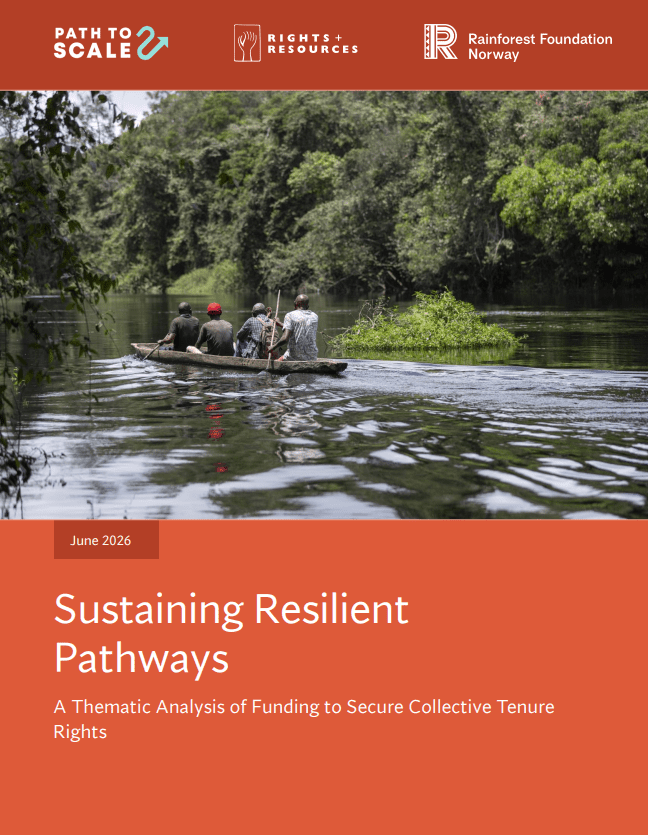
Sustaining Resilient Pathways is the first thematic analysis of how international funding supports these interconnected dimensions of tenure security. Drawing on data from the Path to Scale Funding Dashboard, the brief examines not only how much funding is being mobilized, but how it is distributed across five thematic areas: territorial recognition, implementation of existing rights, policy reform, livelihoods, and organizational strengthening.
The analysis reveals a set of well-established funding pathways, with different donor types supporting distinct, but complementary functions. Multilateral and government-led finance remains central to large-scale territorial recognition and land administration, while foundations and rightsholder-led funds play important roles in strengthening organizations, supporting livelihoods, and advancing policy reform.
As the implementation of the COP30 Forest and Land Tenure Pledge, the Intergovernmental Land Tenure Commitment, and other global commitments advance, this report provides a new baseline for assessing whether funding is reaching the actors, institutions, and functions needed to support communities from rights recognition through rights realization—strengthening the governance systems, livelihoods, and territorial stewardship that sustain collective tenure rights and conservation outcomes over time.
https://doi.org/10.53892/FNJL2869