Blog
A YEAR IN REVIEW: Coalition Victories in 2025
Rights and Resources Initiative

2025 was a deeply challenging year for our sector, testing our coalition in unprecedented ways. But despite this, our coalition members claimed some major wins through their remarkable courage and resilience.

17 .12. 2025  
6 minutes read
SHARE

As the world’s largest solidary network for Indigenous Peoples (IP), local communities (LC) and Afro-descendant Peoples (ADP) and with over 20 years fighting for their rights to own and conserve their territories against deforestation, climate change, land grabs, and extraction— RRI’s 200+ members, donors, and allies made these victories possible. The work is far from done, but here are a few big wins that are worth celebrating!

1. Attracting New Funding Commitments

Throughout 2025, RRI monitored new commitments to drive donor accountability and played a pivotal role in mobilizing and shaping the new Forest and Land Tenure Pledge. Through data-driven advocacy at the sidelines of major global events including The First Congress of IPs and LCs from the Forest Basins in Brazzaville – which was co-organized by RRI with the Global Alliance of Territorial Communities and hosted by the Central Africa Network of Indigenous and Local Populations (REPALEAC,) Climate Weeks in London and New York, and The Pledge We Want campaign, we helped expand the pledge to more ecosystems and new donors. Our Path to Scale initiative’s research and regular convenings kept up the pressure on funders and directly influenced the final Pledge language to center more direct funding for communities. 

In collaboration with the Global Land Alliance (GLA), RRI’s efforts also contributed directly to national commitments towards the Intergovernmental Land Tenure Commitment to significantly scale up the recognition of IPs,’ LCs,’ and ADPs’ land rights in seven countries. The initiative, shepherded by the Forest and Climate Leaders’ Partnership, will broadly define the global land rights agenda for the next five years.

2. Propelling the Afro-descendant Movement 

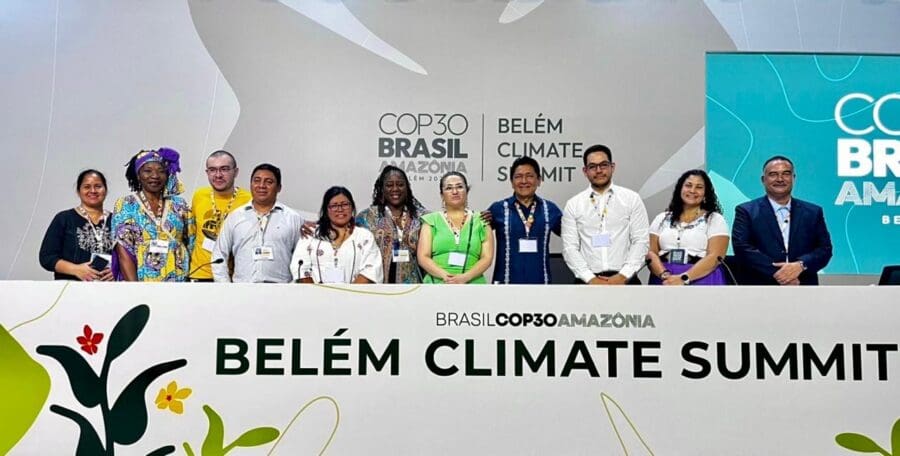
RRI’s direct support for the Afro-descendant Peoples’ movement contributed to the historic inclusion of the term “People of African Descent” in four official UNFCCC COP30 documents. This milestone marked a key structural shift toward formal recognition of ADPs as rights-holders within the global climate action framework. 

Our efforts also led to the explicit inclusion of Afro-descendant tenure commitments in the Intergovernmental Land and Tenure Pledge, and setting specific land tenure goals within the Program to Accelerate Solutions for Afro-descendant Lands (PAS Afrodescendente). The PAS was approved by the COP30 Presidency and is coordinated by the governments of Brazil and Colombia with RRI’s support. In recognition of its consistent technical leadership for the movement, RRI was recommended to serve as the PAS secretariat by both governments.

PAS launch during COP30 in Belem, Brazil


3. Cultivating Youth Leadership

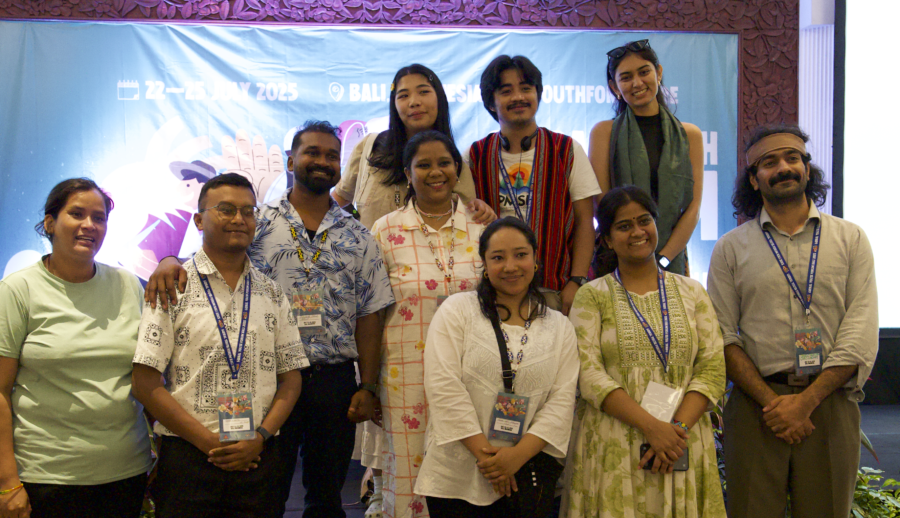
RRI’s first ever Global Youth Forum in Bali, Indonesia, brought together55 young Indigenous, Afro-descendant, and local community leaders from 22 countries in Asia, Africa, and Latin America. The historic convening in July was a collaboration with RRI’s Indonesian partners AMAN and BPAN, and built cross-regional solidarity among IP, LC, and Afro-descendant youth groups. Young leaders developed a Global Youth Roadmap that lays out their priorities for participation and leadership and positions them at the center of coalition planning. They also initiated RRI’s Global Youth Network, which connects regional IP, LC, and AD youth movements into a unified platform to ensure meaningful youth participation in global environmental governance.

RRI’s first Global Youth Forum in Bali, Indonesia


4. Catalyzing Legal Recognition and Implementation of Rights

Despite rising political oppression across the Global South, RRI’s partners advanced legal recognition and implementation of existing reforms across contexts. In Nepal, the Federation of Community Forestry Users Nepal (FECOFUN) successfully advocated for government approval for six community forest user groups’ operational plans. Separately, advocacy by Nepal Indigenous Women’s Federation (NIWF) led to a land commission survey allocating over 300 square yards per household for 53 families.

In the DRC, our coalition’s advocacy led to a groundbreaking victory for inclusive land governance through the country’s first-ever land use planning law. Our partners facilitated legal recognition of 324,549 hectares of forests through community forestry initiatives, land and forest mapping, local land agreements, and promoting sustainable land management plans.

And in Ecuador, we propelled the A’i Kofan Indigenous People’s successful campaign to reclaim the right to conserve and administer 2,000 hectares of ancestral territory located inside a protected reserve. This set a new precedent for Indigenous recognition in Ecuador’s Natural Reserves where, unlike other territories, extractive industries are blocked by the constitution.

5. Positioning Community Women as Leaders

In 2025, RRI supported the Women in Global South Alliance (WiGSA)’s efforts to become a stronger cross-continental network by strengthening its internal capacity, enabling its grassroots members’ participation at key global convenings like COP30 and UN Climate Week, and building evidence-based tools to advocate for women’s access to direct finance. WiGSA received a record number of requests for joining the network in 2025 and now has 26 members with a scope of work in over 60 countries. Its study with RRI, Is Global Funding Reaching Indigenous, Afro-descendant, and Local Community Women? Provided critical data and narratives from the ground to inform governments and donors’ decision-making. It was featured in reports by The UN Food and Agriculture Organization (FAO); the Forest Tenure Funders Group (FTFG); the Women’s Land Rights Initiative (WLRI); and the Land Climate Review.  

69th Commission on the Status of Women, in New York, United States


6. Strengthening Community Monitoring and Governance

We supported community monitoring in key commodity sourcing landscapes through initiatives in Indonesia, Liberia, the DRC, Ecuador, Colombia, and Peru. Each initiative strengthened community governance, generated first-of-their-kind territorial datasets, and expanded communities’ ability to hold companies and governments accountable.  

For example, in North Kalimantan, villages produced their first community-generated evidence base to influence oversight of the Indonesia Green Industrial Zone.  

In the DRC, communities documented land rights violations linked to PHC Congo’s palm oil operations and convened multi-village meetings to strengthen evidence base for future negotiations with the company.  

And in Ecuador, the Indigenous cooperative Wiñak supported the Kichwa communities in using community monitoring to geo-reference 2,857 hectares of cocoa and guayusa chakras and trained them in participatory mapping and EUDR compliance. It also developed an Indigenous-led internal control protocol for deforestation-free production.

7. Channeling Direct Funding to Communities

RRI’s two funding mechanisms, CLARIFI and the Strategic Response Mechanism (SRM), channeled direct and flexible funding to community-led projects throughout the year. These grants amplified community leaders’ campaigns, affected progressive legislation, and built grassroots capacity for research, advocacy, and implementing rights. 

CLARIFI channeled nearly 9.6 million dollars through 83 projects directly with 71 organizations in Africa, Asia, and Latin America. A few big wins include: 

  • In Nepal, CIPRED diversified community livelihoods by training members in handicraft, weaving, and homestay, and built partnerships with local government and park authorities to award them forest access permits, enabling communities to legally harvest non-timber forest products for the first time. 
  • In Ecuador, Fundación Aldea trained 16 communities in land management, ecological restoration, and asserting their cultural identity in the Cala and Cambugán watersheds of the Tropical Andes.  
  • In Cameroon, CLARIFI’s support for REFACOF’s LILAGLÈ Protocol initiative secured over 100 hectares of land for landless women by driving community consensus on women’s land rights in local villages. 


Our Strategic Response Mechanism (SRM) funded 14 new projects in 10 countries in 2025. A few highlights include: 

  • In Kenya, the community led “Now or Never” campaign successfully stopped a proposed 1,050 MW coal plant in Lamu island. Led by the deCOALonize movement, the Centre for Human Rights and Civic Education and the Save Lamu collective, the campaign utilized global forums, film screenings, and the #NowOrNever digital campaign to catalyze a historic court victory upholding the National Environmental Tribunal’s decision to stop the coal plant.
  • In Peru, SRM supported the Harakbut Nation in holding the country’s first-ever census for an Indigenous community, setting a precedent for documenting Indigenous self-identification amidst national policies that limit their visibility in official counts. 
  • Indonesia’s community mapping network, JKPP (Jaringan Kerja Pemetaan Partisipatif) paved the way for stronger tenure security in Indonesia’s coastal areas. It co-developed the country’s first Indigenous Peoples’ Area Indicative Map a spatial analysis identifying 81 million hectares of potential customary territories in Indonesia’s coastal areas. The mapping methodology will nowbe piloted in selected provinces before national adoption. 
Indicative map for Indigenous coastal territories in Indonesia


These are just a few of our collective victories in the year past. To learn more about RRI’s impact over two decades of action to secure a more just and sustainable planet for all communities, check out our documentary on 20 years of collective action or read our 20th Anniversary Achievements Report.


Interested in receiving notifications about new blog posts? Subscribe to The Land Writes Blog now to get new posts delivered right to your inbox.

Subscribe to this blog
To receive new articles directly in your inbox
Subscribe Now!
Subscribe to the RRI mailing list
to receive new articles directly in your inbox
Subscribe Now!
Subscribe to the Gender Justice Digest
to receive new articles directly in your inbox
Subscribe Now!