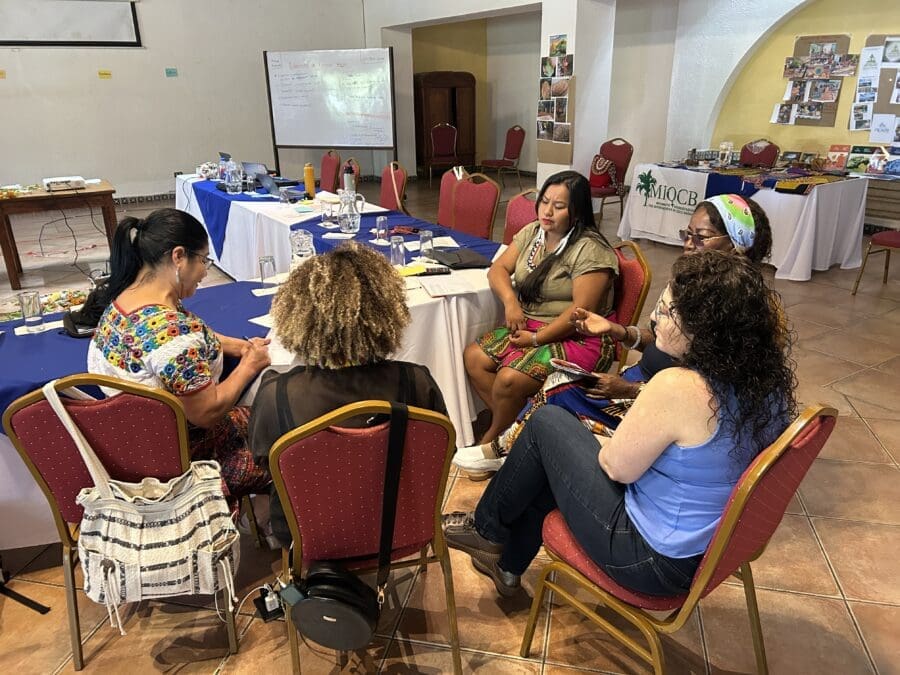
In Guatemala, on April 21 and 22, 2026, 13 women leaders from nine* Latin American countries gathered to coordinate common agendas, strengthen alliances, and define strategic actions to boost their participation in the Rights and Resources Initiative’s Coalition in the region.
The meeting marked a key step in the consolidation of the Women in Self-Sustaining Economies Network, a space that promotes women’s leadership and the strengthening of sustainable economic initiatives led by women. During the workshop, participants agreed on mechanisms for mutual support, including mentoring programs and exchanges of experiences, with the goal of scaling up the impact of their ventures and accessing direct financing.
The meeting stems from an RRI study on 26 women-led community enterprises, conducted in 2025 (read an earlier version of this study for Colombia and Peru here). The 2025 study analyzed market interactions, as well as the strategies, strengths, and limitations of these enterprises, with the aim of fostering a process of exchange and collective strengthening.
The study revealed a challenging yet promising landscape:
- 14 percent of the businesses analyzed have achieved robust commercial consolidation, successfully connecting with broader markets;
- 62 percent are in a mid-stage of development with defined products and services but limited reach; and
- 27 percent demonstrate high potential for scalability and expansion with adequate support.
For these reasons, the participants developed a roadmap to build a network among the enterprises and a solidarity marketing platform to strengthen existing practices and establish ties with other key stakeholders who can inform and support the enterprises’ strategies.
As part of the agreements, they decided to move forward with an independent organizational structure and establish a dedicated Steering Committee, responsible for internal coordination and collaboration with partner institutions on issues of gender and economic development.
“This process within the RRI coalition in Latin America is not new. We have always worked hand-in-hand with women’s enterprises. However, the women themselves have expressed their desire to organize regionally within this Network to continue learning from one another.” — Carla Cárdenas, regional director for Latin America at RRI
The meeting also served as a platform to highlight two successful experiences showcasing women’s leadership. Among them are the Wiñak Association of Ecuador and the Babaçu Coconut Crackers of Brazil.
Wiñak was founded in 1996 in the Archidona canton, in the province of Napo, when Kichwa farming families identified the potential of local products, especially fine-aroma national cocoa, as an opportunity to access niche markets. In response to growing production, they formally organized and, in 2010, established the Wiñak Agro-Artisanal Association, a non-profit community organization dedicated to improving the quality of life of its members, particularly women and youth. Its name, which means “development and progress,” reflects the vision of these producers located in the Sumaco Biosphere Reserve region, who, through training, technical assistance, and market access, strengthen their production systems, reduce intermediation, and promote the conservation of natural resources.
The Interstate Movement of Babaçu Coconut Crackers (MIQCB), active in Maranhão, Pará, Piauí, and Tocantins, is a women-led organization that defends the rights, territories, and livelihoods of the coconut crackers, promoting their political and economic autonomy while valuing traditional knowledge and environmental protection. Emerging from organizational processes since the 1990s, the movement has strengthened women’s leadership, expanded access to land and babaçu groves, and driven advances such as the Free Babaçu Law and the recognition of extractive and quilombola territories. Through collective action and partnerships, MIQCB has improved livelihoods, increased the presence of babaçu products in public markets, and mobilized more than 400,000 babaçu breakers, including young people. Convinced that their future is tied to the forests they protect, the movement continues to fight for dignity, well-being, and the conservation of the babaçu ecosystem.
The businesses represented in the Women in Self-Sustaining Economies Network span a wide range of sectors, including coffee production, clothing tied to Afro-descendant cultural identity, handicrafts and jewelry, baking, cocoa and chocolate, as well as eco-tourism initiatives, demonstrating the potential of local economies to drive sustainable development and social inclusion in the region.
“We women face a double struggle to keep our businesses afloat, because we not only fight for access to financing and training, but we also have to contend with machismo and jealousy within our homes, as well as in other public and private institutions.” — Workshop participants on the need for the Network to overcome these obstacles together
* Brazil, Colombia, Costa Rica, Ecuador, Guatemala, Honduras, Mexico, Panama, and Peru